
Rossella Biscotti

Eternal [Kalpa] is the image of the sun reaching the horizon, that liquid moment it takes to melt into the sea. This sublime sequence, replayed daily at the viewpoint of Phuket’s Promthep Cape, will recur until the world and everything in it has expired. It is the interval when sun and sky, and the sea, their gigantic mirror, conspire to flood the eye with intense colour, before yielding to the darkness. Meanwhile, the sun moves on from this momentous juncture, marking time’s passage no less dramatically in another hemisphere.
However bound by the strictures of modern, clock time, living and non-living things still abide by the cycles of the celestial spheres: coastal villagers stop weaving their fishing nets, cabaret performers paint their faces for a show, fishmongers present the day’s catch on market stalls, tourists return from diving excursions; refugees follow disasters back home on their phone screens; the faithful pray, dugongs graze in the seagrass beds, a great carbon sink, sweetened by sunlight as the sea rises and falls with the moon’s pull.
------
ROSSELLA BISCOTTI
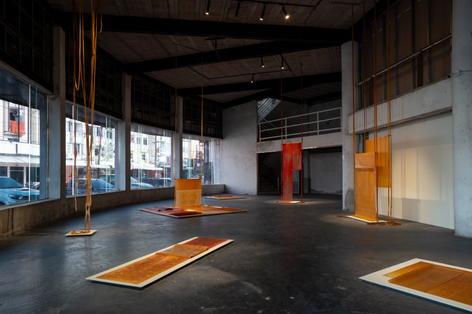
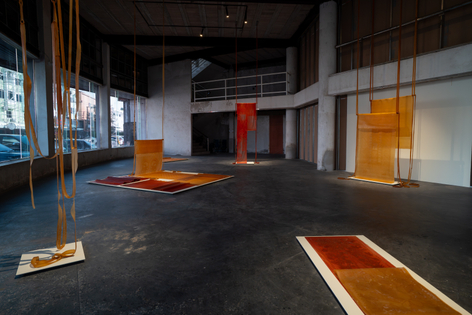
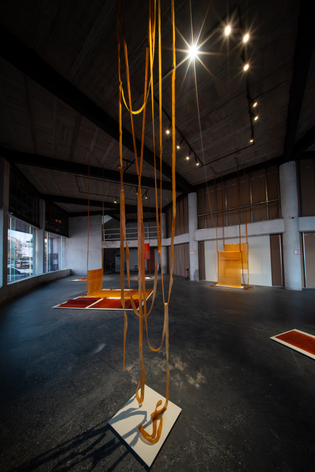
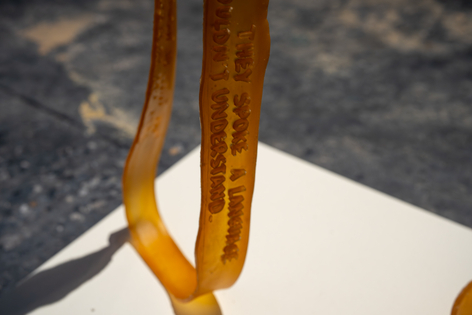
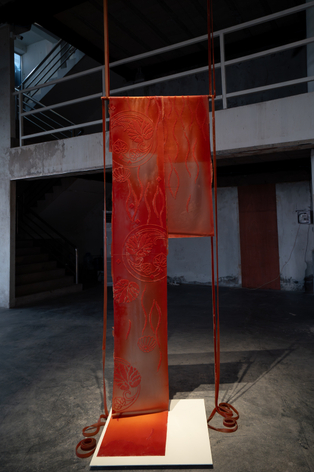
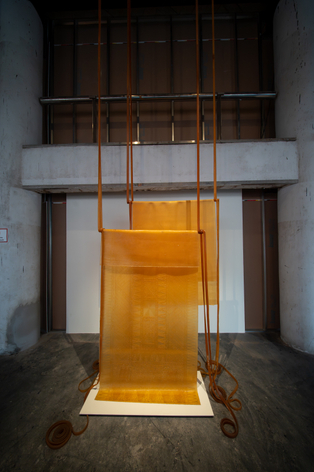
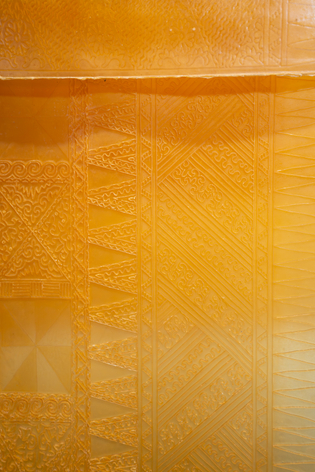
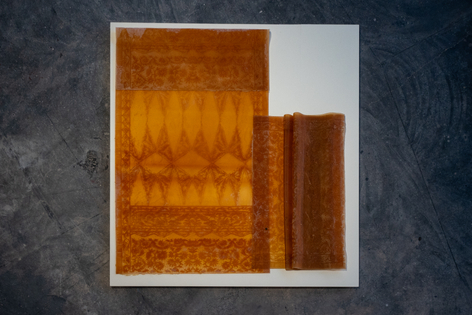
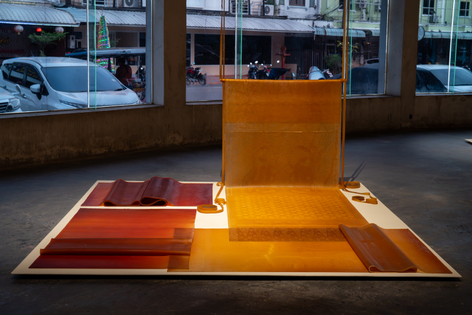
Through her RUBBER WORKS, Rossella Biscotti undertakes the task of articulating intimacy on a historical scale. Made of latex sheets that carry the breath—and stories—of others, these suspended membranes recall batik textiles, hung to display the mastery of handmade technique. More than sculptural objects, they are traces of a commodity that underwrote empires and of the women whose lives were shaped and extinguished within plantation economies from Southeast Asia to the Congo.
The series invokes a genealogy through names of characters drawn from Pramoedya Ananta Toer’s Buru Quartet (1980–88). Orally transcribed during his imprisonment on the island of Buru under Suharto’s regime, Toer’s novels form an archive of voices that colonial modernity sought to discipline through its “ugly blueprint”—the plantation, as theorist Katherine McKittrick writes. Biscotti extends this to Congo-style extraction, linking histories of coercion and dispossession across continents. The rubber’s sheen recalls extraction and globalcirculation; its pliability testifies to bodies pressed into regimes of labour.
Yet Biscotti resists history as didactic narrative. She turns instead to tactility—latex’s capacity to record imprints while remaining open to transformation. The works mourn, and in mourning, they enchant. Porous and mutable, they stage an arena where voices rendered minor might speak, however softly. One such figure is Surati, who in Toer’s story infects herself with small pox to defy servitude. Biscotti translates this refusal into the scarred, reddened stains of her sheets—a reminder that the body’s autonomy can reverberate across time.
The series’ formal language further interprets the strategies of these women: reserved, adaptable, or infectious traits are rendered as patterns recalling regional textiles and batik— the only property women might own. Rubber sourced from plantations in Asia, treated with food colouring, evokes flesh, consumption, and circulation.
This counter-archive departs from Biscotti’s engagement with institutional architectures— casts of tribunal chambers, prison walls, or decomposed ruins, witnesses to dissent and their suppression, like the Italian Red Brigades. Where those works monumentalised evidence, RUBBER WORKS turns it into atmosphere. Fragility becomes political form: the temporary, the pliable, the draped. Within the folds of latex lies an invitation to dwell with the spectral presence of those named only to be erased, and to rehearse, through encounter and enchantment, the art of listening otherwise.
—Edwin Nasr