
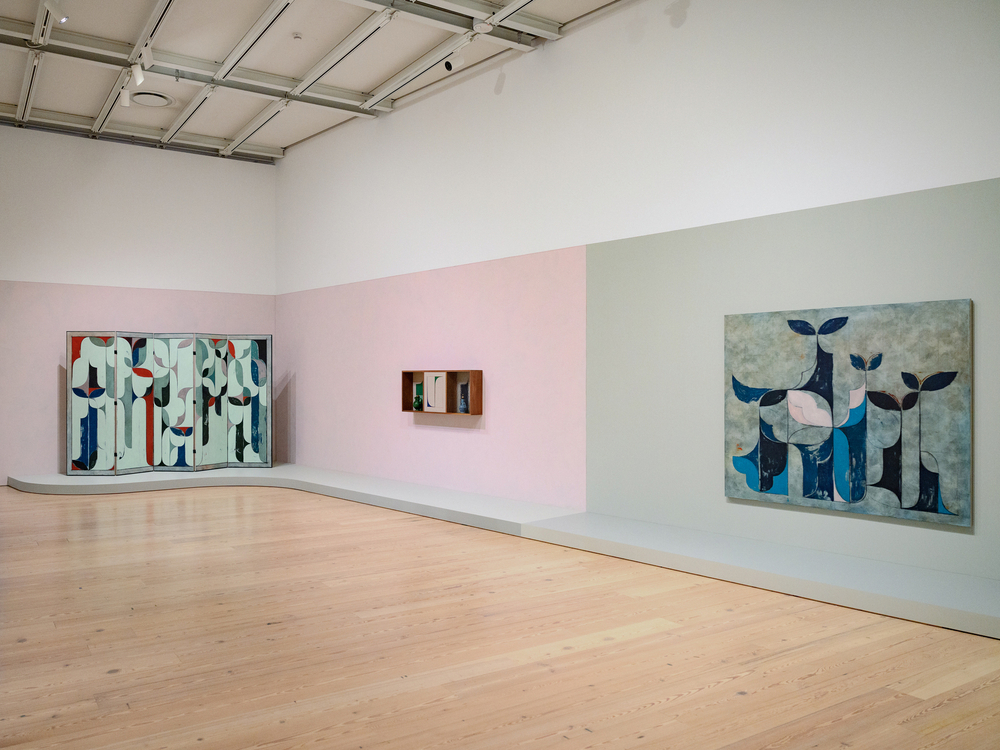
Installation view of Whitney Biennial 2026 (Whitney Museum of American Art, March 8–August 2026)
Photograph by Darian DiCanno/BFA.com. © BFA 2026
The show features 56 artists, duos, and collectives. While curators of recent editions have quietly expanded the definition of “American artist” to include expats and part-time residents in a fairly haphazard way, Guerrero and Sawyer have quite deliberately looked to places where the US has made its presence felt via military interference or occupation — Afghanistan, Chile, Iraq, Japan (specifically Okinawa), the Philippines, Puerto Rico, Vietnam, and elsewhere. This was a smart move, especially given what’s happened even in the last few weeks — a chance to face the history of this country’s interventionism as we embark on a new campaign of chaotic violence.
To say that the exhibition opted out of a strong thesis is not to say that it lacks a curatorial logic, however. It feels like an exhibition. (I say this as a form of praise, not as an indication that I’m lowering the bar, nor as a critique of past, more densely theorized iterations.) In the exhibition texts, the curators mention ideas like relationality and infrastructure, entanglements and kinships — forms of coexisting in this world. These ideas emerge quite clearly in the hanging without becoming overbearing, and without forcing the artwork to stretch to fit the frame.
...
Works by Kamrooz Aram — a solo show within the show — take on histories of Western modernism. His painting has always (under)mined the modernist grid, taking it back to one of its origin points in Islamic painting, but here, he also interrogates how certain forms (the folding screen, the objet d’art) subordinated non-Western art in Western art history.