
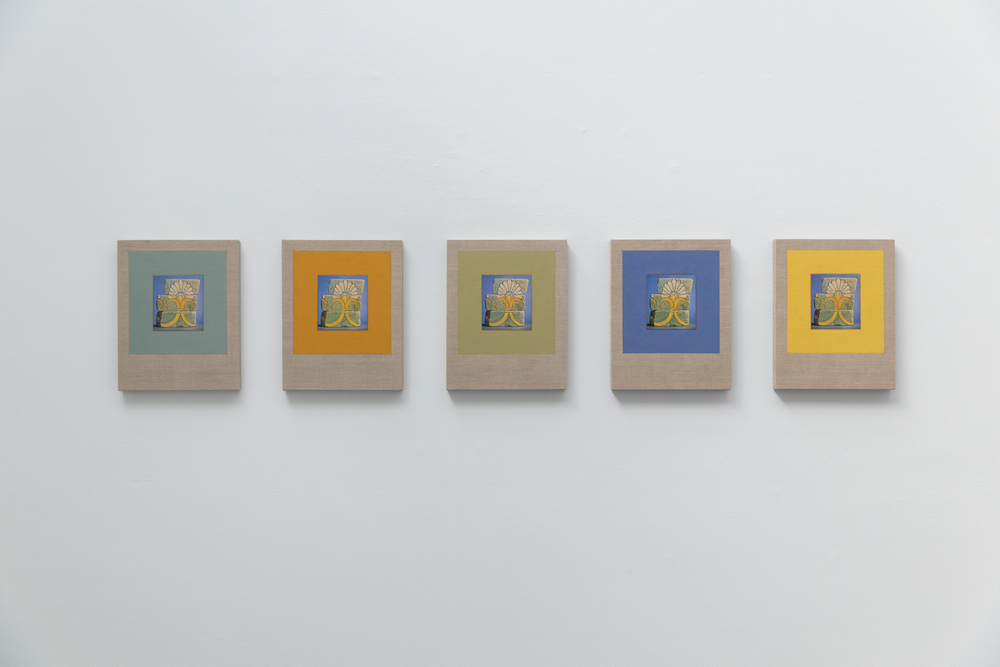
Kamrooz Aram, Variations on Glazed Bricks, 2021
CONSIDER EXPOSED-BRICK WALLS, and the thought arises that bricks can be both functional and aesthetic, on display even as they disappear into the work of dividing space. Kamrooz Aram’s suite of five collages Variations on Glazed Bricks, 2021, calls attention to this ambiguous condition of being both structural and decorative—as it applies not just to architectural ornamentation, but to the work of art itself. Composed of cut book pages, colored pencil, and oil paint on linen, with each successive material bordering the previous one in the panels, the “Variations” are concerned at every turn with crossing their own boundaries. Though these component parts might appear to be clearly demarcated by straight lines, they are in fact structurally dependent upon one another, their color and form modified by what surrounds, supports, and delimits them. Following this precarity from center to margin, it becomes impossible to determine what is proper to the “Variations” themselves, for they come to incorporate “external” objects like critical discourse, the walls they adorn, and the surrounding architecture. Across his multimedia practice, Aram’s project is one of disrupting the habits of classification that render aesthetic judgment perfunctory.
Starting at the middle of each “Variation,” the Iran-born, Brooklyn-based artist pastes the same found image—a photograph of three bricks glazed with a palmette motif. He does not disclose that the pictured object is a fragment of a wall decoration at the Achaemenid palace in Susa, Iran, dated ca. sixth–fourth century BCE, and now held in the collection of New York’s Metropolitan Museum of Art. Nor does he identify the photograph’s source, though I found it in the catalogue of a 1963 exhibition titled “Iranian Ceramics” (Asia House Gallery, 1963). This date is important: All of the photographs Aram appropriates across his portfolio of collages come from books preceding 1978, the year in which the Iranian Revolution began, and in which Edward Said’s Orientalism and Jacques Derrida’s “Parergon” first appeared. The discourse that Aram specifically investigates is of the kind that Said critiques for furnishing the West with authority over the East, an instrument of cultural and geopolitical domination. As a brand of such Orientalism, the discourse represented in the Asia House Gallery catalogue relies on and obfuscates framing devices—what Derrida terms parerga (English: “supplements”; literally: “beside-works”)—in order to define a decorative fragment as an art object. With their mysterious repetition of the catalogue image, the “Variations” incite a desire to know the origins of these bricks and their photograph, yet this information is only to be found in supplemental texts. By frustrating the act of grasping meaning, the artist draws focus to the contextual frames that sustain the museum, exposing their exotifying function.